
Feature Deep Dive
Face Recognition Time Logging: Accurate, Fast, and Employee-Friendly
Clock in with a glance. Prevent time theft by design.
Face recognition replaces badges and PINs with secure, contactless identification. It reduces buddy punching, streamlines shift starts, and gives managers trustworthy attendance data for payroll.
Quick snapshot
- Accuracy: face match at a 95% confidence floor
- Speed: clock-in takes under 2 seconds
- Audit: every entry is tied to a verified identity
Built for modern workforces
From front desks to factory floors, face recognition time logging removes friction at the exact moment that matters most: the start and end of a shift. The result is a smooth experience for employees and high-confidence data for payroll.
The experience is designed to be quick, intuitive, and scalable across locations. No one needs to remember a badge or PIN, and managers can verify attendance at a glance.
How it works
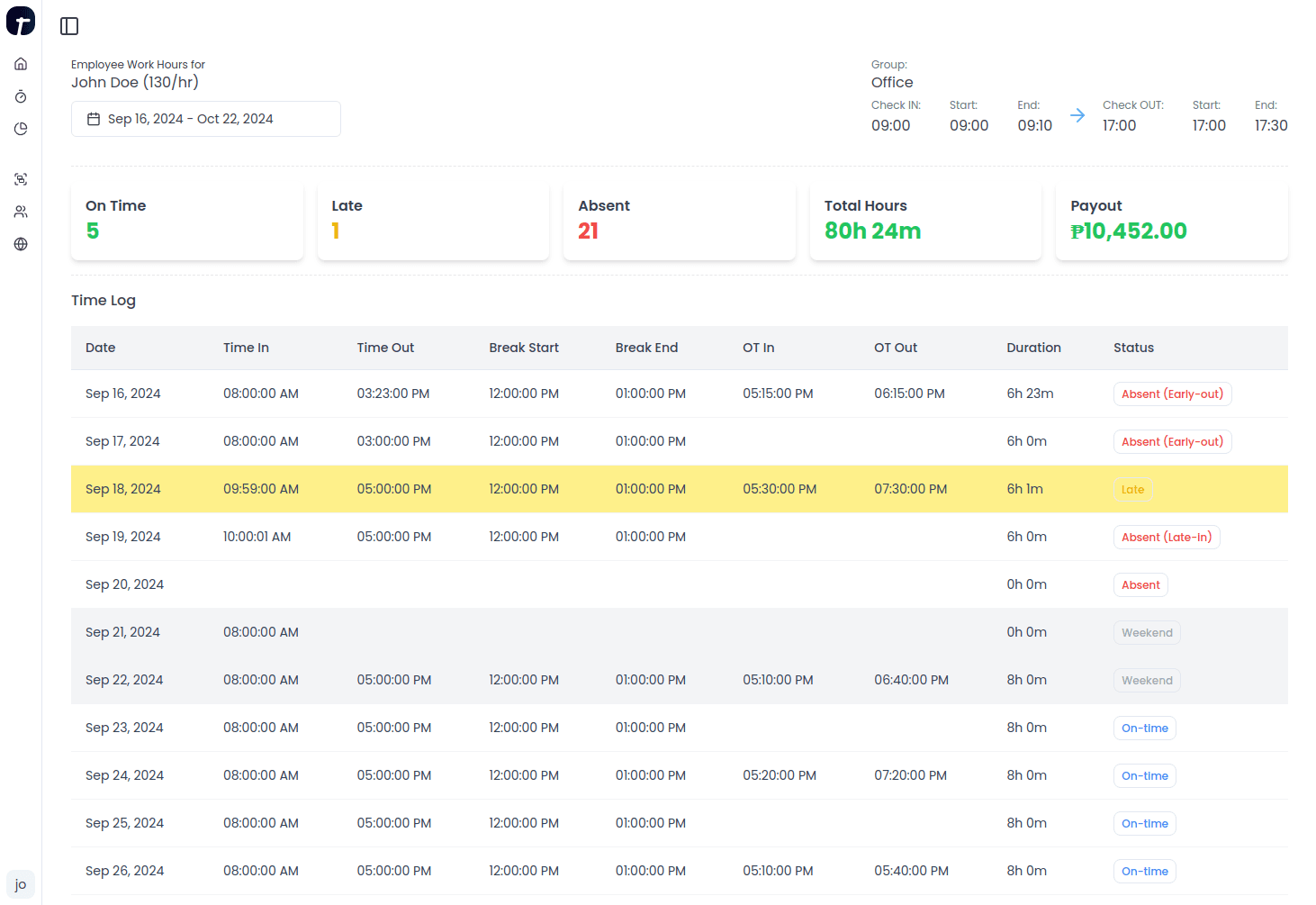
Employees enrol once by capturing a reference photo from the dashboard or the app. At each shift, the scanner checks there is exactly one face in frame, matches it against the people enrolled at that site, and requires a confidence of at least 95% before it writes anything. The entry is then checked against the schedule, and the photo is stored with it.
Managers can view time logs in real time, while employees receive immediate confirmation that their shift start or end has been recorded. This removes the ambiguity of shared devices, lost badges, and manual edits.
Benefits and pros
Eliminates buddy punching
Each clock-in is tied to a biometric match, preventing proxy check-ins and restoring trust in attendance data.
Faster shift starts
No cards to scan or PINs to type. Employees are clocked in within seconds, reducing bottlenecks at entry points.
Higher payroll accuracy
Verified entries reduce corrections and disputes, and payroll runs on the very same records, with the face match and photo still attached.
Contactless and hygienic
Face-based capture avoids shared touch devices, ideal for healthcare, manufacturing, and retail environments.
Actionable attendance insights
Managers get reliable data for overtime planning, absence trends, and staffing optimization.
Scales across locations
Centralized configuration, consistent policies, and unified reporting across sites and departments.
What a clock-in proves
The face match ties the entry to a specific person, and the photo and coordinates captured with it say what that moment looked like. None of it can be handed to a colleague the way a card or a PIN can.
What managers actually review
A scan that does not match, is not on this site's roster, or falls outside the shift window is refused at the device with the reason on screen. What is written was already checked.
Security, privacy, and trust
Face templates are held by AWS Rekognition in a collection created per company, so one customer’s faces are never searched against another’s, and requests travel over TLS. Every entry keeps the photo captured with it and, where the device shared one, the coordinates — so there is a record to go back to.
We recommend transparent employee onboarding with clear consent, local privacy policy documentation, and opt-in workflows. This builds adoption and ensures compliance with regional requirements.
Best-fit use cases
Face recognition time logging is ideal for organizations with hourly workforces, high shift volume, or distributed sites. It is especially effective in retail, logistics, hospitality, healthcare, and manufacturing where clock-in accuracy directly impacts payroll costs and compliance.
Example: a 200-person retail team can reclaim several hours per week by removing manual edits and disputed punches, allowing managers to focus on staffing and customer experience.
Ready to see it in action?
Book a walkthrough or try the live demo to experience the speed and accuracy of FaceBioTime in your own workflows.